

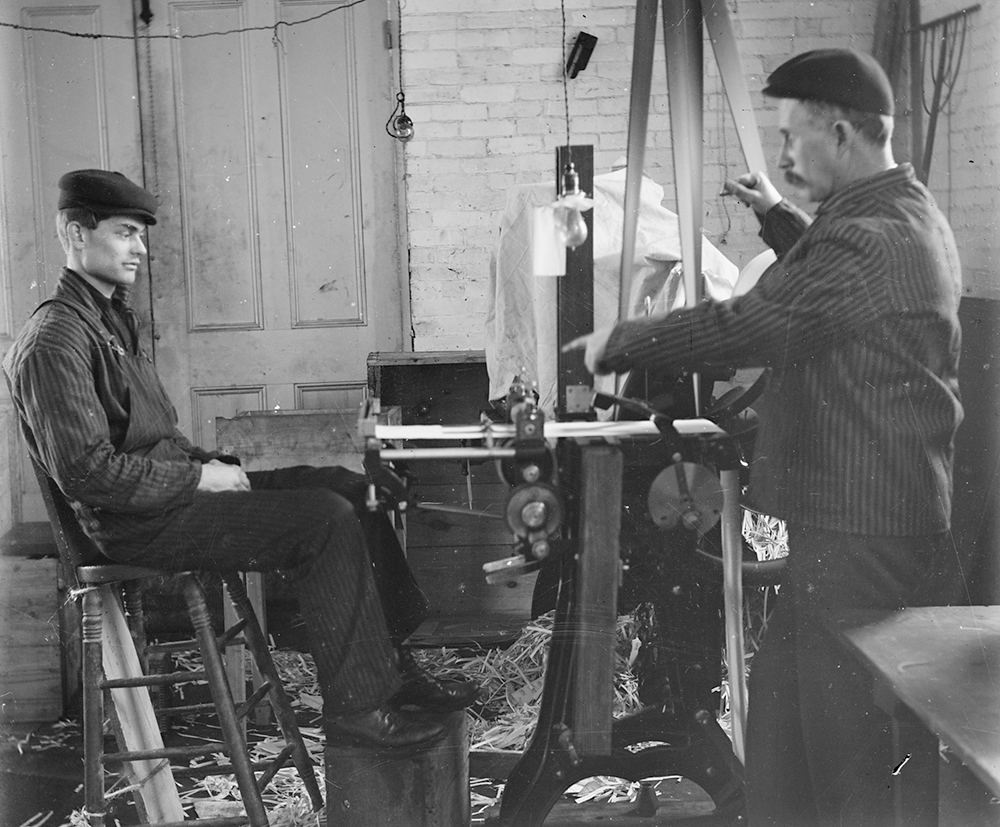
Apprentice in Training, 1890-1910. Maine State Museum. Gift of James Demetropoulos, 82.6.265.
In pre-industrial America, skilled craftsmen used hand tools to create shoes, furniture, household goods, and other products. These highly skilled workers referred to themselves as “mechanics” or “artisans.” They worked in a three-tiered system consisting of the master craftsmen, journeyman who worked for wages, and apprentices in training. Only boys trained as apprentices. Women were not encouraged to work outside the home or farm.
In the 1700s and early 1800s, young men trained under master craftsmen to learn their trade. Parents often required a son to work under a master, so the boy would learn the skills needed to support a family and perhaps own his own shop. Parents signed an indenture (a legal contract) stating that in return for a young man’s work, the master craftsman would provide a room, food, clothing, and an education for a set number of years. This apprentice system served as a secondary education for boys between 10 and 21, and they worked under contract for three to seven years. Because he was indentured, an apprentice was not allowed to leave his master’s service before the agreed upon time. Sometimes apprentices ran away from their master, citing ill-treatment.
The master craftsman owned the shop and had the most experience in his craft. He waited on the customers, hired skilled craftsmen and planned the work. After an apprentice completed his training, the master often promoted him to journeyman. A journeyman was a skilled artisan who worked for wages. Once a journeyman saved enough money, he might become a master craftsman or “mechanic” with his own shop. This system of labor changed, at varying rates, over time and across regions, but became increasingly uncommon as industrialization changed the nature of most labor in the 1800s and 1900s. More...
