


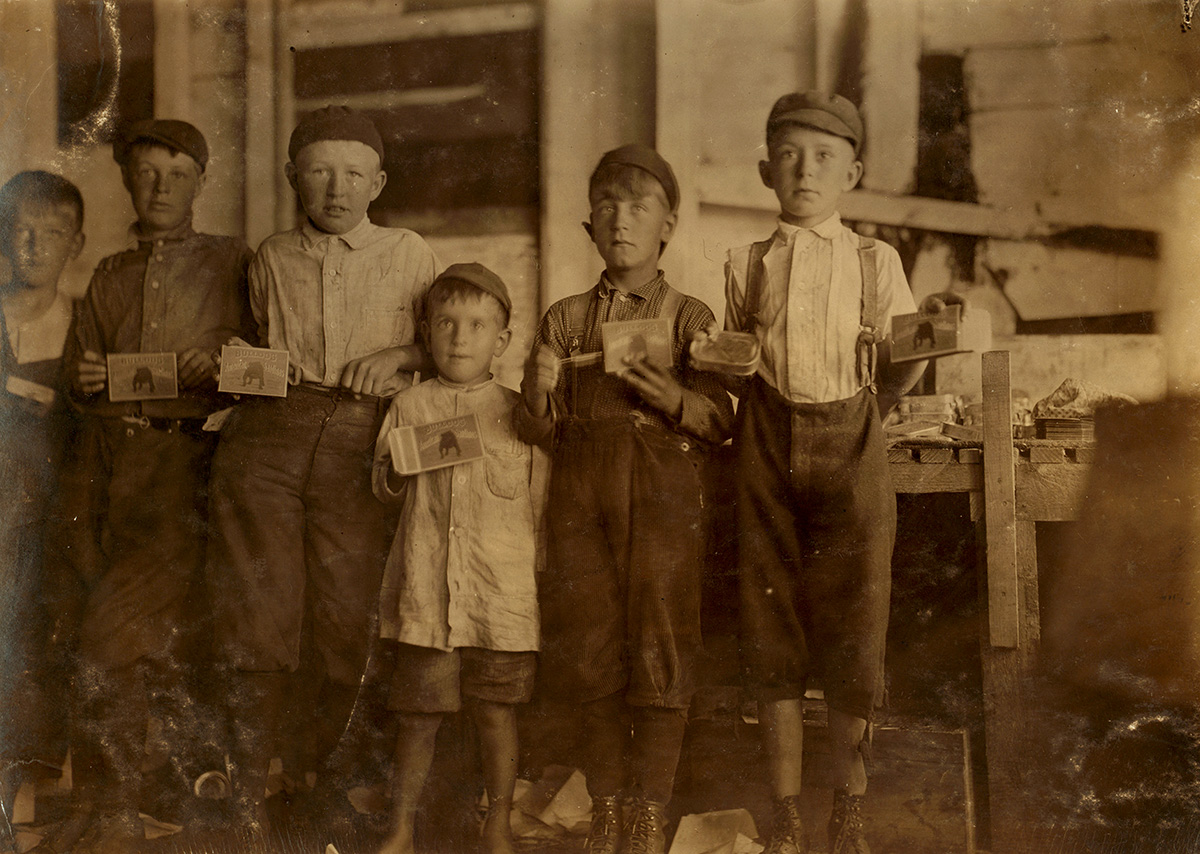
Some of the young cartoners, including five-year-old Preston. Photograph by Lewis Hine, Eastport, Maine, August 1911. Courtesy of the Library of Congress.
Americans’ ideas about childhood have changed dramatically over the last 300 years. In the 1700s, children were viewed as little adults. Except in the wealthiest families, as soon as children were able to walk and take instruction, parents put them to work to maintain the family's home-based and farm economy. As America industrialized, more workers left the farm and home workshops for centralized "manufactories." With children entering the workplace, a family’s economic reliance on child labor became more visible, even though more children continued to work on family farms than enter industry.
Beginning in the 1790s, children held specific responsibilities in the first American factories. Owners valued children for their small, quick hands. For instance, they worked as doffers, exchanging full spools of thread for empty ones in spinning mills. Children as young as five years old worked for a fraction of the wages of an adult. Thus, child labor enabled employers to get the most work for the least money. Children laboring in factories cut short their education, risked health and safety, and missed opportunities to train as apprentices in skills that would allow them to advance themselves later in life.
Society considered children working alongside adults normal and necessary when families needed their children’s income. Families unable to support their needs on the meager wages of one or two parents had few choices other than to send their young children to work in the factories. As the middle class expanded through the 1800s, however, the differences between children in working and middle class families became increasingly apparent. Reformers set to work to improve the lives of poor children. More...
