


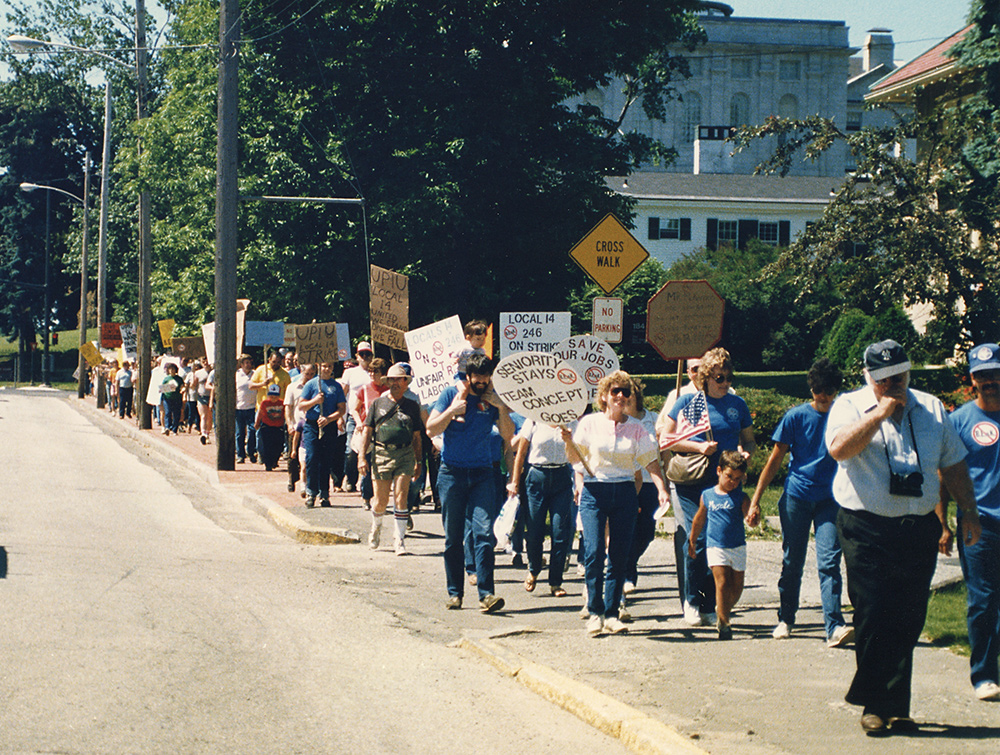
Strikers March on Augusta, photograph by Rene Brochu, Augusta, Maine, June 16, 1987. Courtesy of Maine's Paper and Heritage Museum.
In 1987, after an extremely profitable year, the International Paper Company (IP) moved to change work rules that included lowering workers’ annual income in their American plants. In response, on June 16, 1987, the United Paperworkers International Union (UPIU) went on strike. In Jay, Maine, UPIU’s Local 14 and Local 246 of the International Brotherhood of Firemen and Oilers boasted a membership of 1,250 workers. These workers left the Androscoggin mill to organize massive demonstrations that garnered national attention. Lasting 16 months, the strike was the longest running in New England history.
The strike tore the community apart. IP hired over 1,000 permanent replacement workers enabling the mill to run at almost full capacity. Individuals opposing the strike were ostracized. Some workers who crossed picket lines experienced violence. In the end, the parent union, UPIU, refused to expand the walk-out to include additional IP mills, and the company wouldn’t budge. This loss of national union support caused the strike to collapse. Some strikers were hired back in the following years, but many lost their jobs permanently. More...
