


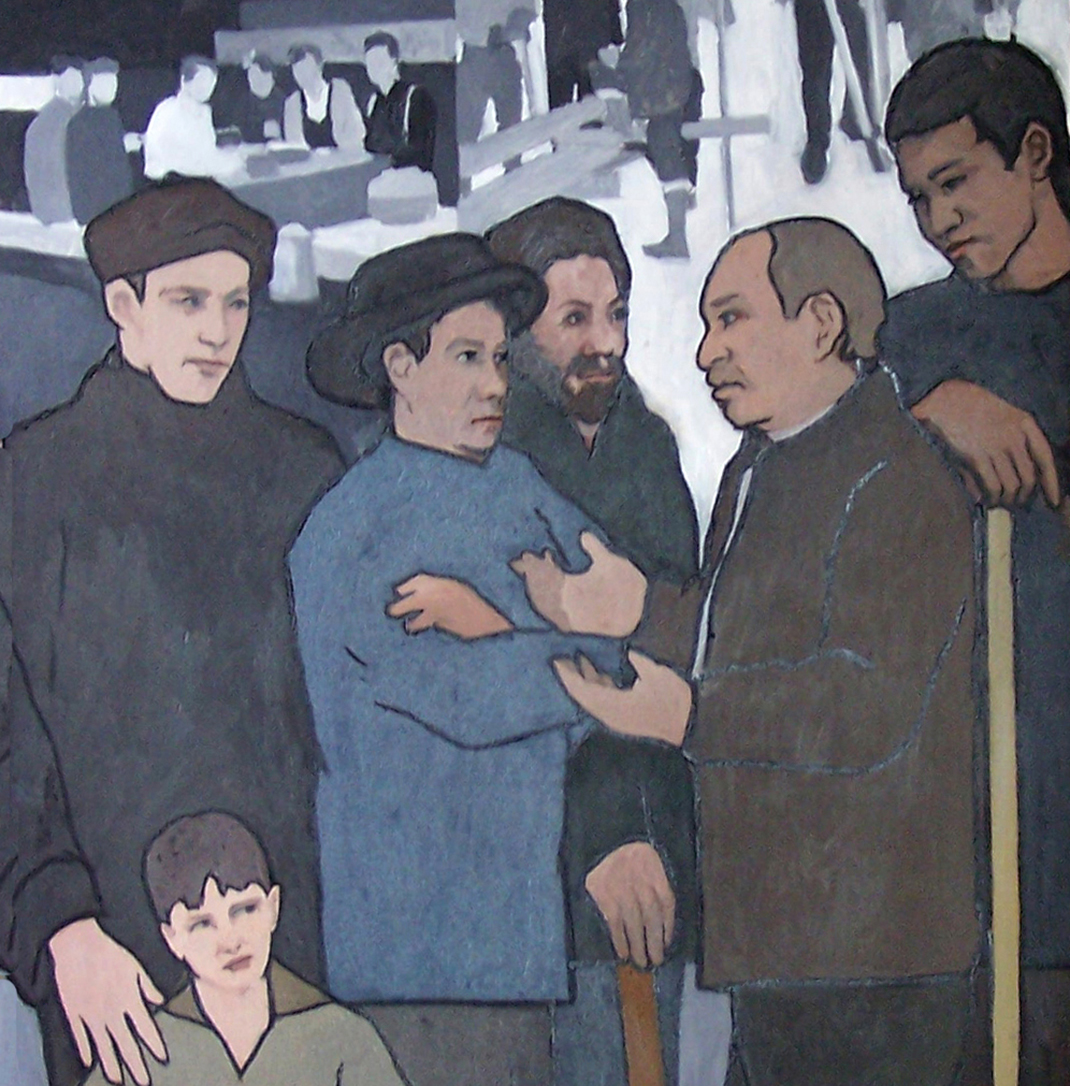
This panel foreground depicts a conversation among loggers and members of the Industrial Workers of the World, a union that attempted to organize Maine’s woodsmen.
Life and working conditions in lumber camps were difficult. Lumbermen set up camp in the late fall. The bulk of the work was accomplished in the frigid winter months when it was easier to move trees through the forest on snow-covered ground. Crews of up to fifty men cut logs and loaded them on sleds drawn by oxen (later by horses and steam or gas-powered Lombard log haulers). The sleds carried the logs to the edges of streams where workers stacked them, waiting for spring river swells to carry the logs to lumber mills downstream.
Before the Civil War most lumbermen came from rural Maine and often worked alongside people they knew. As many seasoned loggers followed the lumber business west, Maine’s lumber operators began using recruiting services in Quebec, New Brunswick, Bangor, Portland, and Boston. Agents solicited men, often immigrants, many of whom had never been in the woods. Recruiters frequently misrepresented the work and living circumstances to potential loggers. For example, recruits who had agreed to work in a lumber mill instead found themselves aboard a train going to a camp deep in the woods where they had to stay and work for as long as five months. They often arrived penniless and needed to be outfitted by the company store. The company took money from the men’s pay to settle such debts, often leaving workers with barely any pay at all.
Sometimes disgruntled loggers abandoned camp. In response, the Maine legislature passed a bill in 1907 making it a crime to leave one’s place of work while owing money to the company store. Critics called this a "peonage" act, after the degrading term "peon." This act forced workers to stay on the job or face jail time; by 1915, hundreds had been convicted under it.
In 1924, the Industrial Workers of the World (IWW) first attempted to organize the 15,000 men in Maine’s lumber and timber industry. The IWW had been operating in Maine since 1906, but no union had been successful with woods workers. The workforce came from many cultural backgrounds and changed camps each season, which made organizing them especially difficult. Although the IWW never achieved its organizing goals for woodsmen, the union succeeded in improving living conditions in the camps and establishing an eight-hour work day at a time when the typical work day might last up to 14 hours. The IWW met resistance, including jail time for IWW leaders, for their efforts in bringing loggers to the union.
