


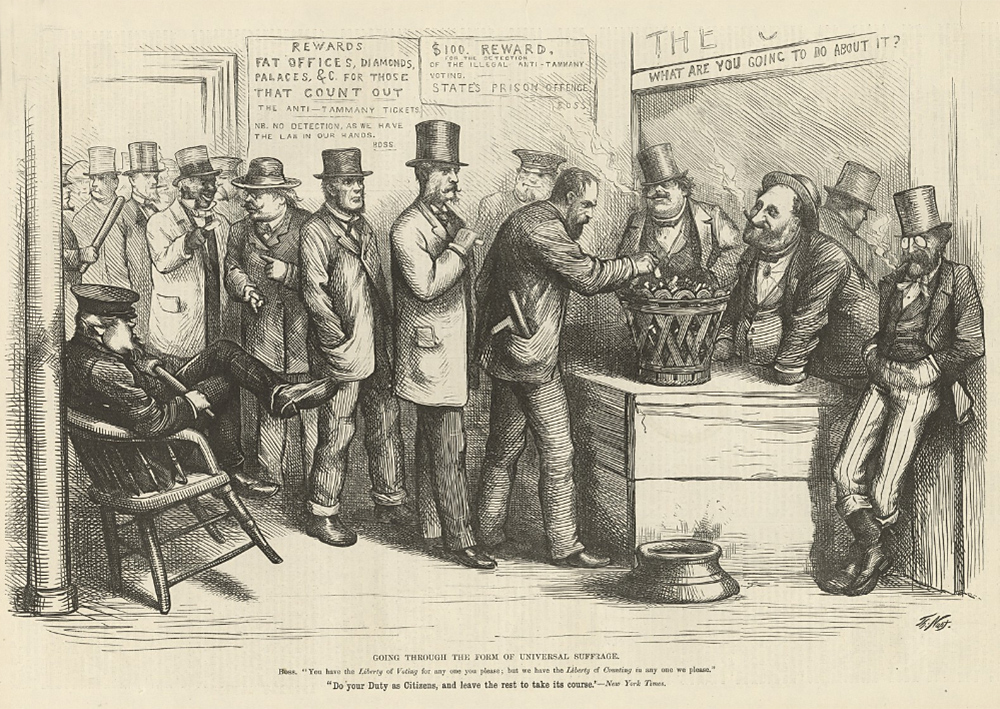
Going Through the Form of Universal Suffrage, illustration by Thomas Nast, Harper's Weekly, November 11, 1871. Courtesy of the Maine State Library.
In the 1890s, Americans voted with secret ballots for the first time. The secret ballot limited employers’ power over their workers. Free from their bosses’ watchful eyes, workers were able to vote in their own interests, rather than as their employer might wish.
In America’s first decades, only white men who owned property could vote. The United States Constitution allowed each state to make its own voting laws. By 1830, most states eliminated the property owning requirement and gave most white men the vote. Initially, a voter cast his vote by voice or by visibly placing a stone or marble in a container to indicate his vote, forcing him to publicly declare his choice.
As America’s population grew, paper ballots emerged as the most convenient voting method. Though paper ballots were easiest to tally, they were not secret ballots. Voters wrote down their candidates of choice and openly handed their ballots to election officials. If a voter misspelled a candidate’s name or office, his ballot would be cast out.
Paper ballots proved difficult for uneducated voters who couldn’t write names on their ballots. To remedy this, political parties pre-printed ballots with their candidates’ names. Because these "party tickets" were different sizes and colors, observers could easily determine how men voted. More...
