


The CIO’s quick success shocked local authorities. The press, religious establishments, and local politicians immediately condemned the strike. The manufacturers took the union to the Maine Supreme Court. The judge, who was from Auburn, ruled against the union on a technicality that was later overturned. He also ruled that anyone picketing or attending a meeting could be arrested.
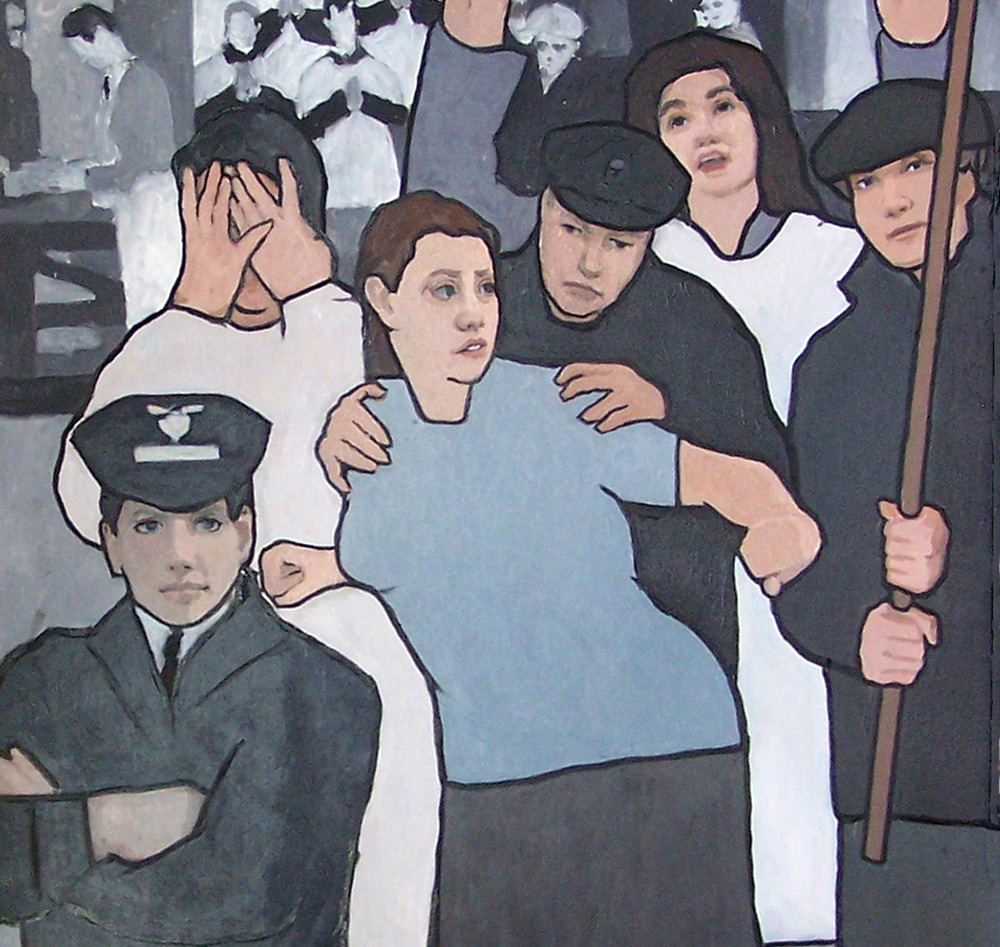
The following day, 1,000 workers marched across the bridge from Lewiston to Auburn. This panel depicts the mass demonstration, later known as "Red Wednesday." When police grabbed a female worker, chaos erupted. Using tear gas and clubs, the police pushed the crowd back to Lewiston. Governor Lewis O. Barrows sent 400 National Guardsmen to join the Auburn and Maine State Police. Authorities arrested the CIO leaders, held them without bail, and sentenced them to six months in prison. The companies hired replacement workers or "scabs."
The National Labor Relations Board, an agency newly formed by New Deal legislation to protect workers’ rights, sent a federal investigator to review the dispute. In his final report, the investigator found that although the CIO had made mistakes, the strike was legitimate. He ordered that official union elections should occur within twenty days and that only the workers employed before the strike could vote. He mandated that the manufacturers negotiate with the CIO. With this ruling, the CIO ordered the workers back to work. The owners refused to hire back most of the 2,000 striking workers, despite existing federal legislation known as the Wagner Act, which gave workers the right to organize and bargain collectively for the first time in U.S. history. In addition to many workers not getting their jobs back, several shoe companies closed, and the CIO was never officially recognized by Lewiston-Auburn shoe companies.
