


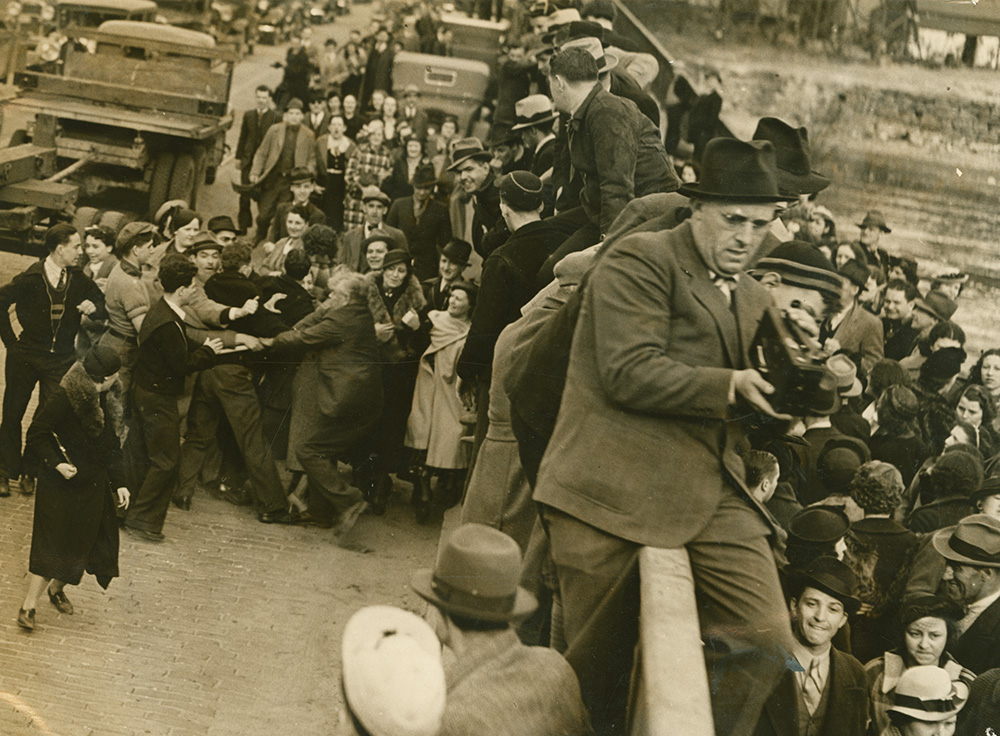
The Battle on the Bridge, Wednesday. Lewiston Evening Journal, Auburn, Maine,
April 21, 1937. Collection of the Maine State Museum, 2018.48.3.
During the Great Depression, shoe workers at 19 factories in Lewiston-Auburn grew tired of earning far less than their Massachusetts counterparts. In 1932, they defied a "yellow-dog contract" that their employers had forced them to sign stating they would never join a union. The workers formed a local union and went on strike. In response, the owners banded together as members of the Lewiston-Auburn Shoe Manufacturers Association (LASMA) and quickly crushed the local union.
Without resolution to their grievances, in 1937 a group of shoe workers requested help from the United Shoe Workers of America, an affiliate of the Congress of Industrial Organizations (CIO). The CIO sent two organizers up from Massachusetts who held weekly meetings of over 1000 people. A CIO representative sent a letter to the LASMA demanding that the factory owners negotiate with the union on behalf of the workers and that the manufacturers agree to a 15% wage increase, a 40 hour work week, and union recognition.
The owners refused to negotiate with the CIO, arguing the union’s representatives were outside agitators who did not represent Maine workers. LASMA offered a 10% incremental raise. With the manufacturers’ refusal to talk with union representatives, organizers called a mass meeting at Lewiston City Hall that drew 3,000 people. The CIO called for a vote to strike. The informal voice vote produced "yes" cheers that drowned out the few dissenting voices. Lacking a documented, unanimous response, the manufacturers questioned the vote’s legitimacy. Nevertheless, thousands of workers walked off the job for 94 days, bringing shoe making to a temporary standstill in the cities. More...
