


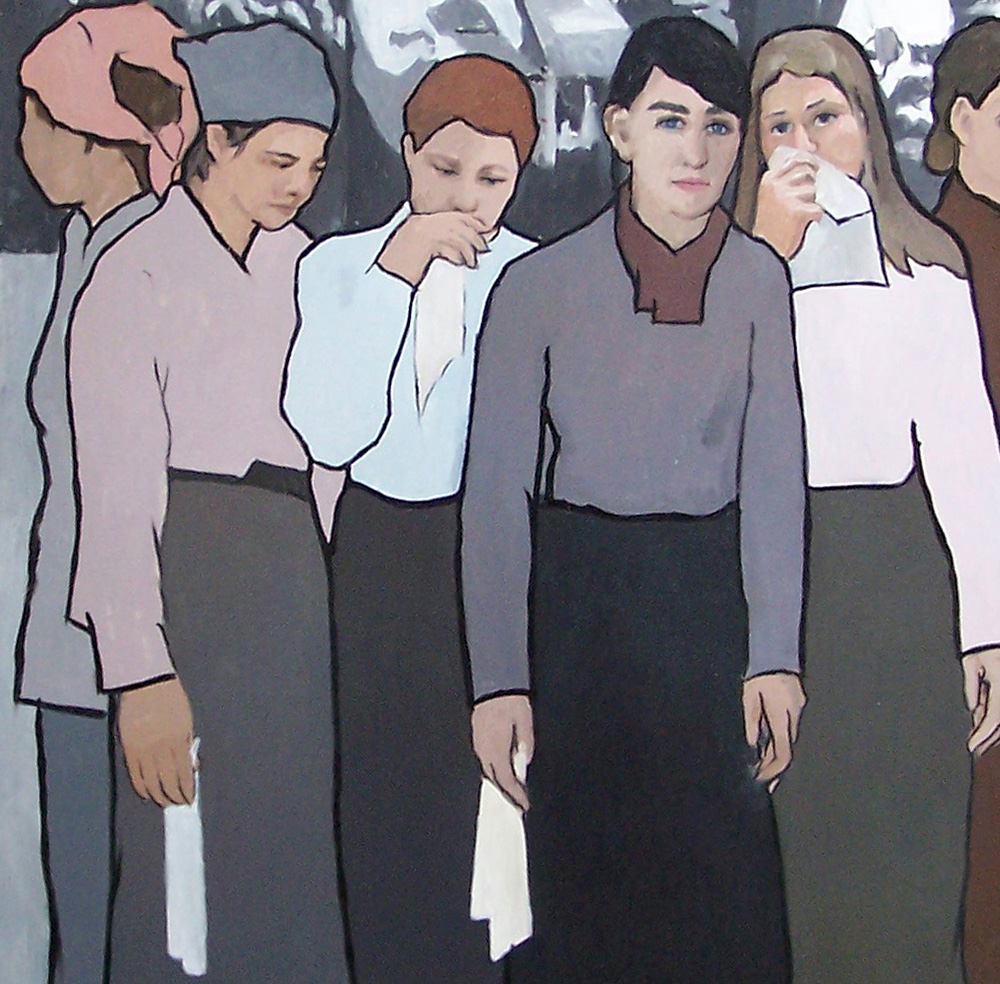
In the early years, mill girls enjoyed a very different life than they experienced on the farm. Mill owners supported libraries and lyceums where lecturers shared the most current ideas. In order to convince Yankee farmers to let their daughters come to the cities to work, mill owners set a moral code. Boarding houses had curfews and the girls attended mandatory church services on Sundays. During the rest of the week, however, the young women worked twelve to thirteen hours a day under difficult conditions.
Mill owners believed that humid air kept threads supple and less likely to break. As a result, they nailed mill windows shut, making work spaces extremely hot and humid. Limited ventilation caused many to develop brown lung disease (byssinosis) from extended periods of breathing cotton fibers. In this panel, the workers holding handkerchiefs represent those sickened by working conditions.
By 1850, mill owners began cutting wages and speeding production. In response, many of New England’s "mill girls" moved into other occupations or back home. Over time, an influx of immigrants, largely Irish and French Canadian, replaced them in the mills. Often uneducated and poor, these new arrivals agreed to work long hours for low wages at a fast pace. Through the end of the 1800s, mill workers lived and labored in increasingly desperate conditions.
