


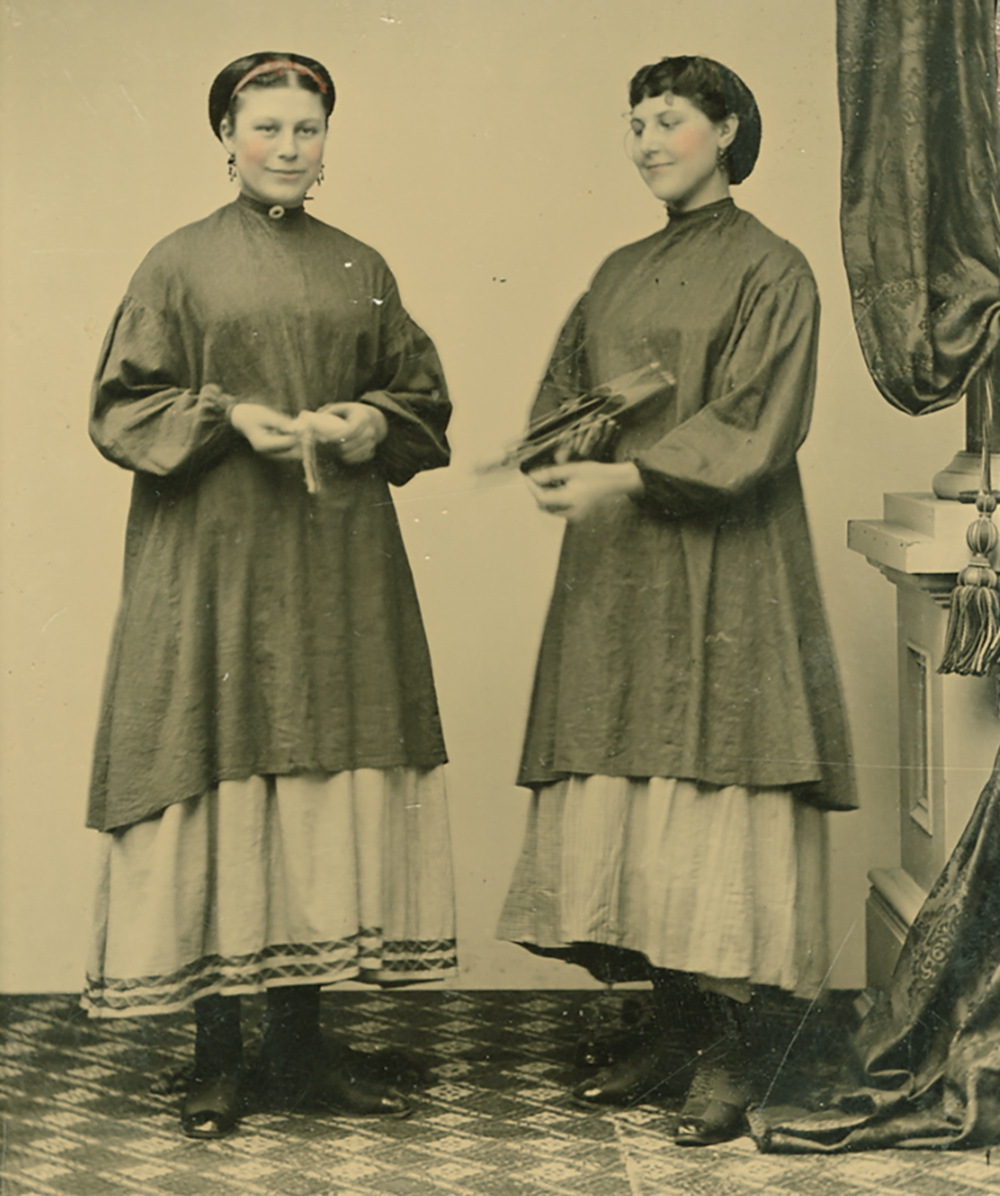
Weavers, New England, ca. 1875. Maine State Museum, 68.174.55b.
As early as the 1820s, women, known as "mill girls," began working in textile mills, becoming part of the earliest waves of industrial workers. Thousands of young Maine women left their family farms to work in textile mills. They first flocked to Lowell, Massachusetts, and later to mills throughout Maine. While millwork was monotonous, unhealthy, and often uncomfortable, it meant a certain freedom for young women leaving the farm.
In the 1820s, the first large textile factories equipped with power looms opened in Lowell, Massachusetts. Within ten years, Massachusetts’ textile mills employed as many as 5,000 young women from Maine. In the 1830s and 1840s, Maine’s first large textile mills in Saco, Biddeford, Augusta, and Hallowell drew thousands more. By 1850, Lewiston and Auburn emerged as the "spindle" center of the state. Before the Civil War, most textile workers were unmarried girls and women ages 10 to middle age. Most expected to work only a few years before they married. Their wages brought them new economic freedoms, while helping their families back home. More...
