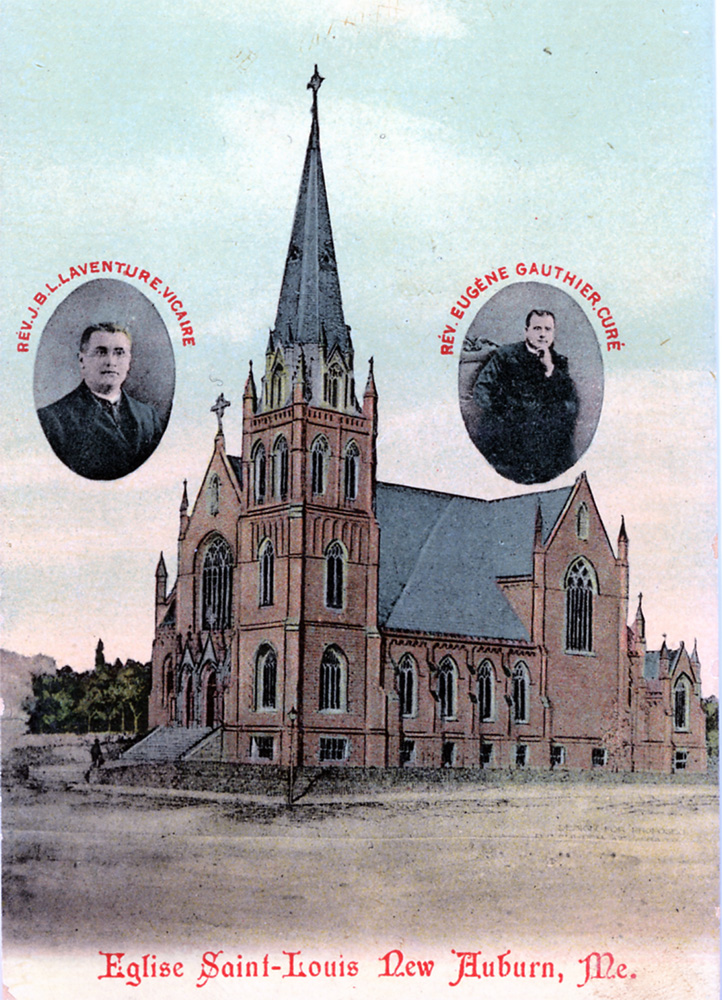
Eglise St. Louis, New Auburn, Maine, ca. 1910. Courtesy of the Maine Historic Preservation Commission.
Eglise St. Louis, New Auburn, Maine, ca. 1910. Courtesy of the Maine Historic Preservation Commission.
Although the majority of the strikers were French-Canadian Catholic, priests at Lewiston's Catholic Churches spoke out against the strike. The priests condemned the Congress of Industrial Organizations (CIO) because they felt the union had "let itself be penetrated with Socialists and Communists," who were reputed to be atheist.
The labor strife had divisions along ethnic lines. Most CIO supporters were French-Canadian Catholic workers. The leadership and members of the locally based union, the Lewiston-Auburn Shoeworkers Protective Association (LASPA), were largely English-speaking, with personal connections to local authorities and businessmen. These local ties softened the LASPA members' stance. This, along with its lack of funds and organizing experience, contributed to the LASPA's inability to successfully negotiate with the local factory owners.